
Understanding What Prevents Customers From Buying Online
PROJECT OVERVIEW
To support eCommerce customer acquisition, I led an end-to-end mixed-method research study to identify high-value customer segments and uncover friction within the online purchasing experience.
I translated behavioral and usability data into prioritized product opportunities, helping stakeholders determine what to improve first.
Portfolio Brief
For portfolio purposes, I’m showcasing primarily how I go about my research projects and how I organize my research & data analytics
Project Scope & Research
Research Objectives
Validate existing assumptions around which customers are most likely to purchase online / via ecommerce
Validate the right target customers/segments
What (if any) pain points or opportunities exist for these target customers in being able to purchase from a supplier (via e-commerce)
What existing points of friction currently exist in our online shopping flow that needs to be optimized for the user experience
01 / THE CHALLENGE
The Challenge
The business wanted to increase eCommerce customer acquisition, but we needed stronger evidence around who we should target and what was preventing those customers from successfully purchasing online.
I designed the research to connect customer behavior with usability data—helping us understand both who we should design for and where the experience needed to improve.
02 / IDENTIFYING THE RIGHT CUSTOMERS
Identifying the Right Customers
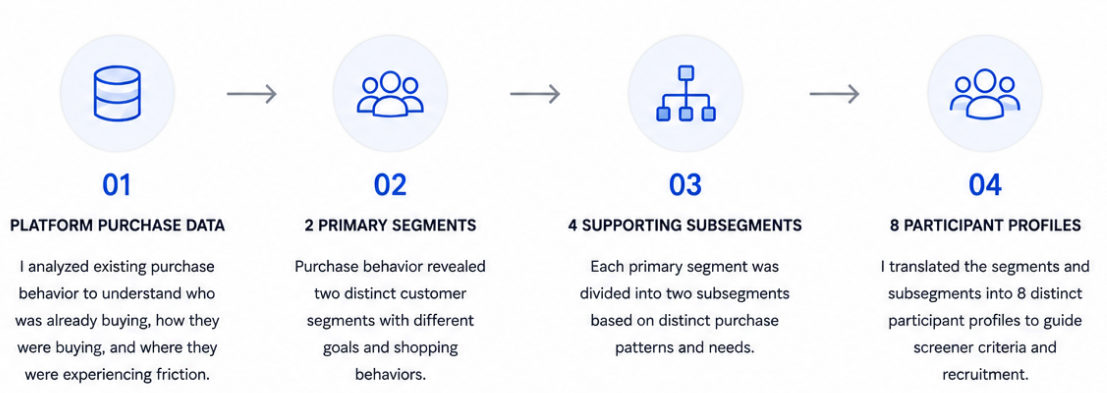
Before recruiting participants, I analyzed purchase behavior within the existing platform to understand which customers were already demonstrating patterns relevant to our eCommerce acquisition goals.
This analysis revealed 2 primary customer segments and 4 supporting subsegments, which I translated into 8 participant profiles. These profiles informed the screener criteria and recruitment strategy through AlphaSights.
03 / DESIGNING THE STUDY
Designing the Study
I designed a mixed-method study combining moderated usability testing and semi-structured interviews to understand both how customers interacted with the eCommerce experience and the behaviors, expectations, and motivations behind their purchasing decisions.
Each 60-minute session included a 30-minute usability test followed by a 30-minute customer interview.
04 / MEASURING THE EXPERIENCE
Measuring the Experience
I paired behavioral observations with quantitative usability metrics to understand not only where users struggled, but how consistently and significantly those issues affected the experience.
Together, these measures helped distinguish isolated usability problems from patterns that warranted deeper investigation and prioritization.
TASK SUCCESS
Could participants successfully complete the task?
SEQ
How difficult did the task feel?
TIME ON TASK
How efficiently could participants complete it?
SUS
How usable did the overall experience feel?
Additional measures: Likert ratings · Confidence intervals · Standard deviation
05 / FINDING PATTERNS IN THE DATA
Finding Patterns in the Data
I coded observations across participants and tasks, then mapped recurring behaviors into a rainbow chart to identify patterns across the study.
This allowed me to distinguish isolated feedback from systemic usability issues and identify themes supported across multiple participants.
KEY THEMES
01 — Pricing & total cost transparency
02 — Checkout expectations
03 — Account creation friction
04 — Product discovery & navigation
05 — Supplier trust & familiarity
06 / TURNING RESEARCH INTO PRIORITIES
Turning Research into Priorities
Rather than presenting stakeholders with an unranked list of usability findings, I developed a severity framework to evaluate which issues warranted the most attention.
Each issue was scored based on its importance to the task, impact on the user experience, and frequency across participants—creating a consistent, evidence-based approach to prioritization.
07 / FROM SIGHTS TO ACTION
From Insights to Action
After identifying and prioritizing the most significant usability issues, I translated the findings into actionable product recommendations.
Potential solutions were evaluated against expected effectiveness, issue severity, and implementation complexity to help determine which opportunities offered the greatest value and should be prioritized for further exploration.
RESEARCH FINDING
↓
POTENTIAL SOLUTION
↓
EFFECTIVENESS × SEVERITY
↓
IMPLEMENTATION COMPLEXITY
↓
ROI / PRIORITY
08 / OUTCOME & IMPACT
Outcome & Impact
The research gave stakeholders a clearer understanding of who we should design for, where customers were experiencing friction, and which opportunities warranted the most attention.
By connecting customer behavior, usability findings, issue severity, and solution feasibility, I transformed the research into an actionable framework the team could use to make more informed product decisions.
DURATION
2 months
Oct - Dec 2021
TOOLS
Userlytics, Excel, AlphaSights, Figma, HotJar
ROLE
Project Lead / UX Researcher
METHODS
User Interviews, Moderated Usability Testing
TOOLS
Userlytics, Excel, AlphaSights
TIMELINE
Week 1
Define scope & target participant profiles
Hold recruitment kick-off call
Week 2 & 3
Run recruitment & review profiles
Design research study
Week 4
Conduct user interviews & usability tests
Week 5
Synthesize Findings
Week 6
Hold report-out
WHAT WE NEEDED TO LEARN
01
Which customer segments are most likely to purchase online?
02
Are our existing assumptions about these customers accurate?
03
What prevents customers from purchasing through eCommerce?
04
Where does the current shopping experience create unnecessary friction?
CUSTOMER INTERVIEWS - 30 MIN
USABILITY TESTING - 30 MIN
Semi-structured interviews explored:
Purchasing behaviors
Expectations
Existing workflows
Supplier preferences
Barriers to online purchasing
Participants completed four critical eCommerce Tasks
Checkout
Evaluate the purchasing and checkout process.
Product Discovery
Find and evaluate a specific product.
Account Registration
Create and navigate an online account.
Shopping Experience
Navigate key areas of the broader eCommerce experience.
Metrics Captured:
Task Success - SEQ - Time on Task - SUS - Likert Ratings
MEASURING SEVERITY
TASK CRITICALITY
How important was the affected task to the overall experience?
×
IMPACT
How significantly did the issue affect the user's ability to complete the task?
×
FREQUENCY
How consistently did the issue occur across participants?
↓
SEVERITY SCORE
THE RESEARCH DELIVERED
01 — Customer Segmentation
Defined priority customer groups using existing purchase behavior.
02 — Usability Insights
Identified recurring barriers across critical eCommerce workflows.
03 — Severity Prioritization
Quantified findings based on criticality, impact, and frequency.
04 — Product Opportunities
Translated findings into prioritized recommendations based on value and feasibility.
KEY TAKEAWAY
Research became more than a list of findings: it became a framework for deciding what to improve and why.